



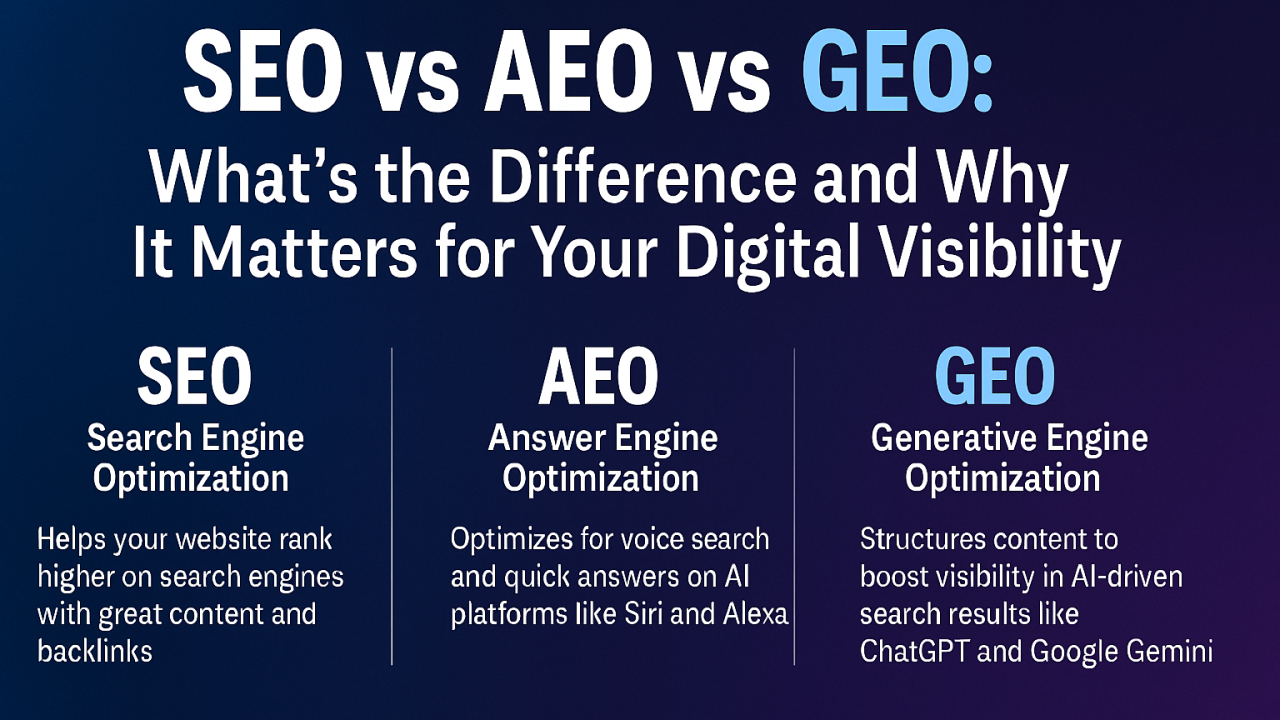

SEO, AEO, and GEO all aim to increase your online visibility, but they target different ways people find information.
| Aspect | SEO | AEO | GEO |
|---|---|---|---|
| Full form | Search Engine Optimization | Answer Engine Optimization | Generative Engine Optimization |
| Goal | Rank higher in search engine results | Become the direct answer to user questions | Have AI assistants cite or use your content in generated answers |
| Platforms | Google, Bing | Google Featured Snippets, voice assistants (Siri, Alexa, Google Assistant) | ChatGPT, Gemini, Claude, Perplexity, Copilot, AI Overviews |
| Content style | Comprehensive, keyword-focused pages | Clear, concise answers to common questions | Authoritative, well-structured, trustworthy content that AI can understand and reference |
| Success metric | More organic traffic | Featured snippets, voice search results | Mentions, citations, and recommendations by AI systems |
1. SEO (Search Engine Optimization)
SEO helps your website appear higher in traditional search results.
Example:
A user searches:
“Best digital marketing course”
SEO aims to get your page ranked on the first page of Google.
Typical techniques:
- Keyword research
- Quality content
- Backlinks
- Fast website
- Mobile-friendly design
- Technical optimization
2. AEO (Answer Engine Optimization)
AEO focuses on providing direct, accurate answers that search engines or voice assistants can present immediately.
Example:
A user asks:
“What is SEO?”
Instead of showing ten links, Google may display a featured snippet with a short definition from a website.
AEO techniques include:
- FAQ pages
- Question-and-answer format
- Structured data (schema markup)
- Short, clear explanations
- Lists and tables
3. GEO (Generative Engine Optimization)
GEO is about making your content more likely to be used by AI-powered search and chat systems when they generate responses.
Example:
A user asks ChatGPT:
“Recommend the best CRM software for small businesses.”
Instead of listing search results, the AI generates an answer using information from trusted sources. GEO helps your content become one of those trusted sources.
Good GEO practices include:
- Publishing original, authoritative content
- Clearly identifying authors and sources
- Keeping information current
- Organizing content with descriptive headings
- Using structured data where appropriate
- Demonstrating expertise, experience, authority, and trustworthiness (often summarized as E-E-A-T)
Quick comparison
SEO
- Optimizes for search engines
- Goal: Higher rankings and website traffic
AEO
- Optimizes for answer engines and voice search
- Goal: Be the direct answer to a user’s question
GEO
- Optimizes for AI-powered generative systems
- Goal: Be cited, referenced, or used in AI-generated responses
Think of it this way
- SEO: “Help people find my website.”
- AEO: “Help search engines use my content as the answer.”
- GEO: “Help AI systems understand, trust, and incorporate my content into generated responses.”
Today, many businesses combine all three approaches. A well-optimized site should rank well in search results (SEO), answer common questions directly (AEO), and provide authoritative, structured content that AI systems can understand and reference (GEO).